

Let’s face the truth: most businesses don’t fail because the founder lacks passion or ideas. They fail because the cash runs out long before the opportunities do. Roughly 82% of Indian startup failures share the same villain—cash flow chaos.
With 71% of SMEs now relying on external funding just to stay operational, and a jaw-dropping $1.955 trillion MSME credit gap, “figure out your finances later” has officially expired as an excuse.
The upside? Fixing finances is far more doable than it feels. We’ve seen SMEs go from “constant firefighting” to “smooth, boring stability” in as little as 60–90 days. Delayed payments, surprise penalties, runaway expenses—they’re not doom signals. They’re symptoms of missing systems. And systems can be built.
Quick Wins You Can Implement This Week
No fancy tools. No consultants. Just discipline:
- Cash Flow Sweep: Spend 30 minutes tracking this week’s inflows and outflows—patterns jump out fast.
- Compliance Reminders: Set early alerts for your next three deadlines—GST, TDS, ROC.
- Idle Cash Check: See what’s sitting idle. ₹10 lakh doing nothing = ₹70,000 a year slipping through your fingers.
Costly mistakes we see repeatedly:
- Not renegotiating vendors (10–15% overspend)
- Treating idle cash like a trophy instead of deploying it
- Budgeting in silos
- Manual compliance that leads to expensive catch-up
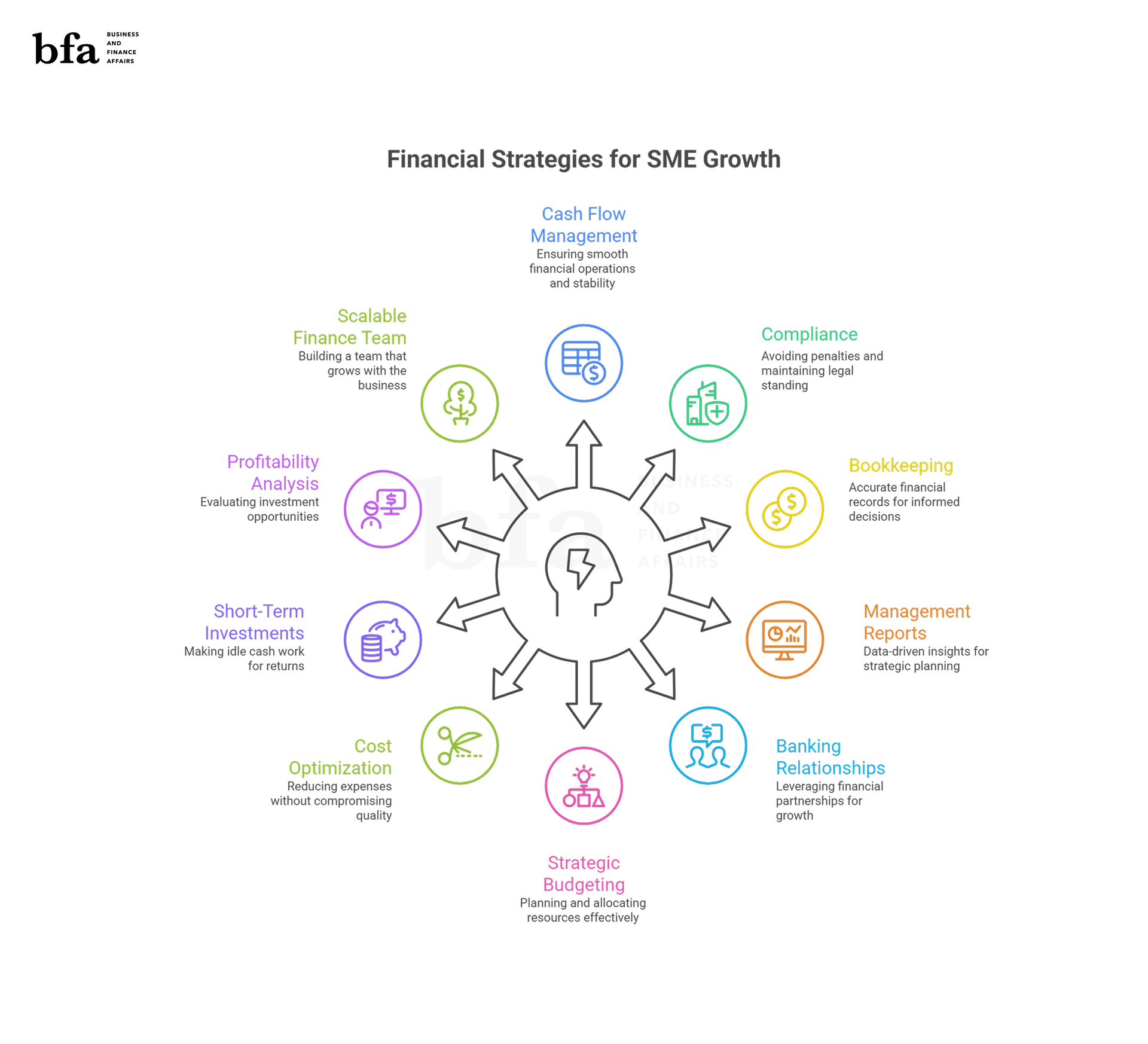
1. Master Cash Flow Management — Your Business’s Lifeline
Most founders treat cash flow like a storm to endure. The ones who last treat it like weather they can forecast.
In 2024, over 70% of Indian SMEs borrowed just to keep operations running, not for growth. Payments came late. Expenses weren’t tracked. Planning was reactive.
Practical Focus Areas:
- Invoice quickly
- Collect faster
- Pay slow (respectfully)
- Project 12–18 months ahead
The setup that works:
- 13-week rolling cash flow forecast
- Standard monthly cashflow & budgeting exercises
Action Step: Track weekly inflows/outflows even on a simple spreadsheet.
Read more on 5 Cash Flow Killers That Will Destroy Your Growing Business
2. Lock Down Compliance — The Quiet Business Killer
Compliance mistakes can wipe out months of profits overnight and hurt investor/bank relationships.
2025 Penalty Landscape:
- ROC late filings: ₹100/day
- GST penalties: ₹100/day or 0.5–1% of turnover
- TDS defaults: 18% interest annually
- ITR audit triggers: up to ₹1.5 lakh
Compliance usually slips for a structural reason rather than a careless one — most often because the person who quietly owned it left. What closes the gap:
- Implemented Zoho Books for automated GST/TDS filing
- Built structured, repeatable compliance protocols
- Resolved pending notices and avoided penalties
They stayed penalty-free afterward.
Quick Actions:
- Industry-specific compliance calendar
- 14-day advance reminders
- Monthly compliance reviews
Virtual CFO clients reduce compliance misses by 70% using proactive systems.
3. Nail Timely Bookkeeping — Your Business Radar
If cash flow is your pulse, bookkeeping is your eyesight. Without timely books, you’re guessing. And guessing is expensive.
Bookkeeping Rhythm:
- Daily: Record entries
- Weekly: Categorize, reconcile petty cash
- Monthly: Bank reconciliation, monthly close
- Quarterly: Deep audit & compliance check
Books two or three months behind, reconciliations done by hand, invoices going out late — these symptoms travel together.
We implemented:
- Zoho Books with auto bank statement imports
- Weekly reconciliations
- Structured monthly closes
- 80% error reduction
- Real-time cash visibility
- Zero missed invoices
- Staff freed for strategic work
4. Management Reports — From Data to Action
Reports are not for compliance—they’re for clarity and faster decisions.
Reporting Stages:
- Early Startups: Weekly cash + burn
- Growing SMEs: Monthly P&L + KPIs
- Mature Businesses: Quarterly balanced scorecards + rolling forecasts
The one-screen rule: your dashboard should fit on one screen. Start with five core metrics. Fifty-page monthly decks get built and do not get read.
A reporting cadence that holds up:
- Weekly: Cash flow & compliance updates
- Monthly: Sales, gross profit, full account review
- Quarterly: Timesheet analysis + sales efficiency reports
5. Build Strategic Banking Relationships — Your Hidden Profit Center
A bank that knows your business gets you better rates, working capital when you need it, and faster forex processing.
What we use ourselves:
- We run our own current account as an SBI Surabhi with sweep-in FDs, so idle balances earn without anyone moving them.
The arithmetic: ₹50 lakh sitting in a sweep account at 6.5% earns ₹3.25 lakh a year. The same balance in a plain current account earns a fraction of that.
6. Implement Strategic Budgeting — Your Roadmap
Budgets are guardrails, not cages. Collaborative budgets grow companies faster.
Replacing gut-feel budgeting with something checkable:
- Annual budget split into monthly targets
- Cost forecasting
- Hiring & cash flow alignment
7. Optimize Costs — Trim Fat, Keep Muscle
An annual review of every recurring cost reliably finds money that does not come out of quality or headcount. What makes it work is that it happens on a fixed date rather than when somebody remembers.
Three places the money usually is: vendor spend that has never been consolidated, software nobody cancelled, and senior roles bought full-time when they are needed part-time. On the last one the gap is wide — a full-time CFO costs roughly ₹45–90 lakh a year, and a part-time arrangement buys the same seniority without the full-time commitment.
What a spend review actually examines:
8. Make Idle Cash Work — Found Money
Idle cash is like idle staff—wasted potential.
Smart Moves:
- Sweep accounts
- Short-term FDs
- Liquid funds (7–7.5% YTM)
Rule: Keep 15–20% of working capital immediately accessible.
9. Analyze Major Investments — No Blind Bets
Every investment—insurance, tools, expansion—needs filters:
- IRR > 15%
- Payback < 3 years
- Worst-case still survivable
Insurance is the clearest case. Most policies are renewed without anyone comparing the market. Getting three quotes and negotiating at renewal is half a day of work, once a year.
10. Build a Scalable Finance Team — Grow Without the Weight
Teams should get smarter, not bigger.
Finance staff without finance leadership is a common shape. What fills the gap:
- Complete virtual finance team
- Bookkeeping, compliance, reporting, budgeting processes
- Data-driven insights
Read more on CFO vs Virtual CFO: What is Right for Your Business
Your 90-Day Action Plan
Month 1 — Foundation:
- Map 3 months of cash flow
- Build compliance calendar
- Shift to cloud bookkeeping
- Pick 5 metrics & build dashboard
Month 2 — Optimization:
- Review banking setup
- Start budget planning
- Audit top vendor contracts
- Deploy idle cash smartly
Month 3 — Strategy:
- Evaluate next investment
- Identify finance team gaps
- Automate compliance reminders


