

You have probably seen the number: nine out of ten Indian businesses fail within five years.
It comes from a 2017 study by the IBM Institute for Business Value and Oxford Economics. Two things get dropped every time it is repeated. It measured tech startups, not businesses. And it is nine years old.
That matters, because a funded tech startup and a family manufacturing business do not fail the same way. One runs out of runway between rounds. The other runs out of cash while profitable, or loses the customer who was sixty per cent of revenue, or gets a compliance bill nobody had planned for.
This piece is about the second kind. Where a number below has a source, it is linked and dated. Where it does not, it is not here.
The Graveyard Statistics (Prepare to Feel Uncomfortable)
Here’s what nobody tells you at those “Be Your Own Boss” seminars:
- Year 1: One in four businesses vanish.
- Year 3: Nearly half are gone.
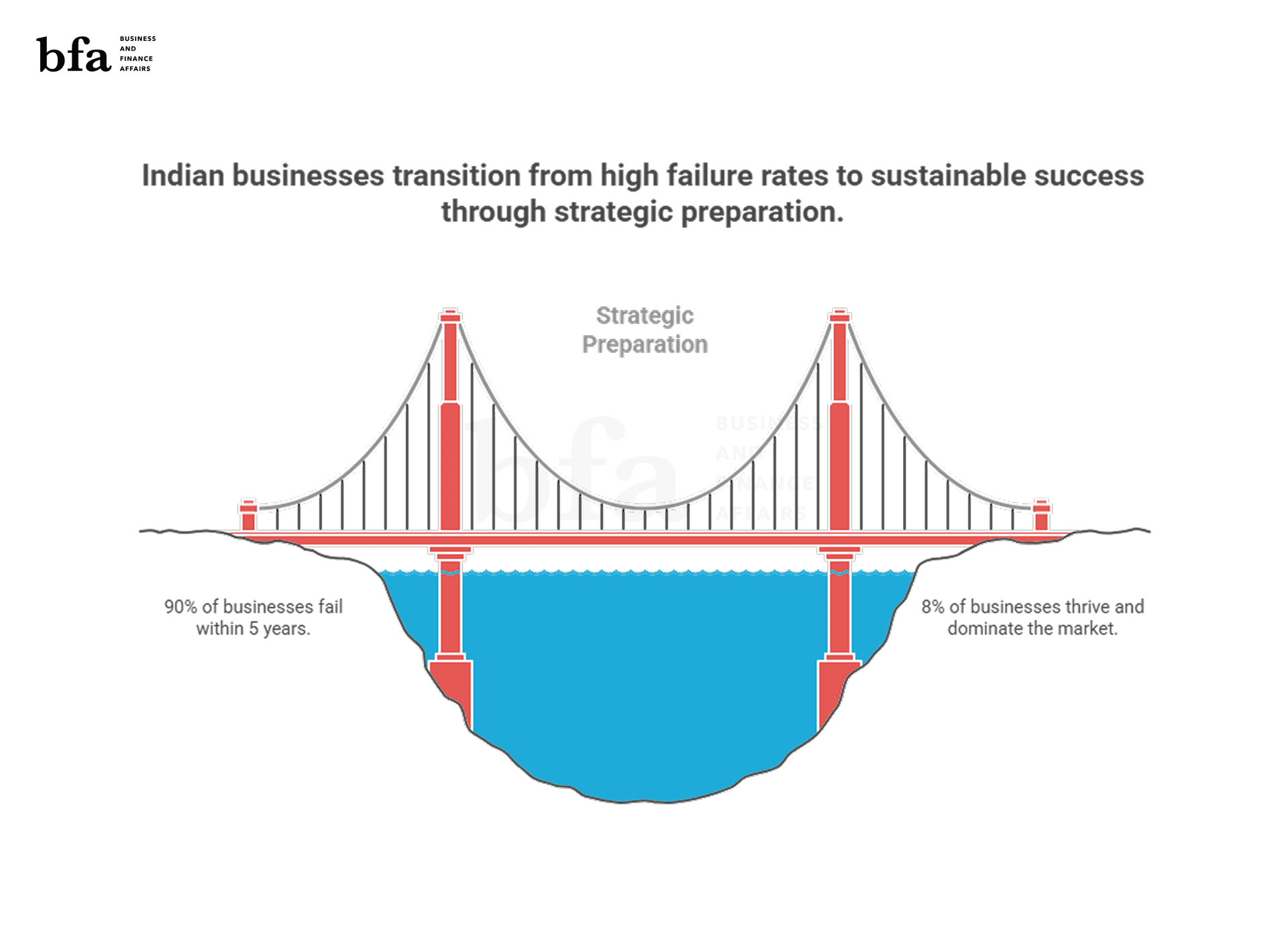
- Year 5: Around 90% join the business graveyard.
- Year 10: Only 8 of every 100 still stand.
India may boast 117 unicorns, but 25% of our listed companies are loss-making and 40% barely cross ₹1 crore in annual profit.
The gap between ambition and execution is enormous.
Why Indian Businesses Die (No Sugar-Coating)
1. “If You Build It, They Will Come.” Spoiler: They Won’t.
The Problem: 35 - 42% of failures happen because no one really wants what’s being sold.The Reality: Entrepreneurs often fall in love with their idea, not their customers’ problems.
2. Money Math That Would Make Accountants Cry
The Problem: 16 - 40% fail due to poor financial management.The Reality: Mixing business and personal money, ignoring forecasts, and running blind on cash flow leads to financial suicide.
3. The Family Business Curse
The Problem: 65% of family-run businesses don’t survive beyond the second generation.The Reality: Family disagreements, poor succession planning, and unclear roles kill potential faster than competition.
4. Death by a Thousand Forms
The Problem: Endless compliance, changing tax laws, and filing penalties eat away time and cash.The Reality: Many founders spend more time surviving the system than growing the business.
5. Marketing Like It’s Still 1995
The Problem: 22 - 56% of businesses fail because they can’t sell effectively.The Reality: Ignoring digital marketing is like refusing to have a phone in the 90s.
The Hidden Killers Nobody Talks About
- The Rent Trap: Overheads that bleed your profits dry before break-even.
- The Talent Exodus: Skilled workers don’t stay; better ones leave.
- The Corruption Tax: “Small favors” that pile up into real costs.
- The Copycat Culture: Your ideas get cloned faster than you can trademark them.
Plot Twist: Some Actually Make It (Here’s How)
Despite all this, some businesses don’t just survive but they thrive.
Here’s what they do differently:
They Talk to Customers
Before building anything, they listen. Validation beats assumption.
They Treat Money Like It’s Sacred
Separate accounts. Forecasts. Expense buffers. They manage, not guess.
They Go Digital
They meet customers where they already are — online.
They Get Professional Help
They bring in experts like CAs, lawyers, and Virtual CXOs — early. Prevention is always cheaper than cure.
They Play the Long Game
They don’t chase vanity metrics. They focus on sustainable growth and cash flow.
The Government Wants to Help (Sort Of)
Startup India, MSME schemes, credit initiatives are all good in theory. But in practice, the support system has gaps.
Smart founders treat these schemes as bonuses, not lifelines.
So... Should You Still Try?
Absolutely yes, but with your eyes open.
Because while 92% of businesses fail, the 8% that survive often go on to dominate.
They didn’t just dream but they prepared. They tracked. They sought professional guidance when needed.
Success in India isn’t about luck or passion. It’s about:
- Resilience against bureaucracy
- Discipline in money management
- Humility to learn
- And systems that scale sustainably
The Bottom Line
Your business might fail if you run it like most do. But if you plan smarter, manage better, and stay financially disciplined, your odds skyrocket.
Because success in India isn’t about being the smartest but it’s about being the most prepared.


